The Illusion of Conversational Productivity
In the early wave of AI-assisted software engineering, conversational chat windows became the dominant interface paradigm. Developers opened a sidebar in their IDE, typed questions like "How do I refactor this function?" or "Write a test case for this component," and copied the resulting response back into their editor.
While this conversational interaction model provided quick answers for isolated syntax questions, enterprise engineering teams quickly hit a ceiling. Chatbots treat software development as a series of disconnected, single-turn text exchanges rather than an interconnected, stateful system.
The result is Conversational Friction: developers spend more time copying code snippets back and forth, fixing minor syntax discrepancies, and re-explaining project context than they save by using the model.
Conversational Model (High Overhead):
[ Developer ] <---> [ Chatbot Sidebar ] ---> Copy/Paste Code ---> Manual Fixes ---> Broken Tests

Governed Sub-Agent Model (Zero Overhead):
[ Developer Spec ] ---> [ Governed Sub-Agent ] ---> AST Scope & Compilation ---> Synthetic Test Passing ---> Clean PR
Why Chat Interfaces Fail in Complex Codebases
Chatbot interfaces suffer from four fundamental structural flaws when applied to production codebases:
- Context Window Pollution: Chat sessions accumulate stale context over time. As developers ask unrelated questions in the same thread, the model's attention mechanism degrades, leading to compounding hallucinations and contradictory code suggestions.
- Lack of AST Awareness: Standard chat assistants operate on raw text buffers rather than Abstract Syntax Trees (ASTs). They cannot verify whether a suggested method exists in downstream microservices or if an imported type contract has changed.
- Bypassing Static Analysis: Code generated in a chat window bypasses linters, type checkers, and security scanners until the developer manually places it into the file system.
- No State Reflection: When a chatbot's code suggestion fails a test, the user must manually copy the error log back into the chat window to request a fix—introducing human latency into what should be an automated loop.
Governed Sub-Agents vs. Conversational Assistants
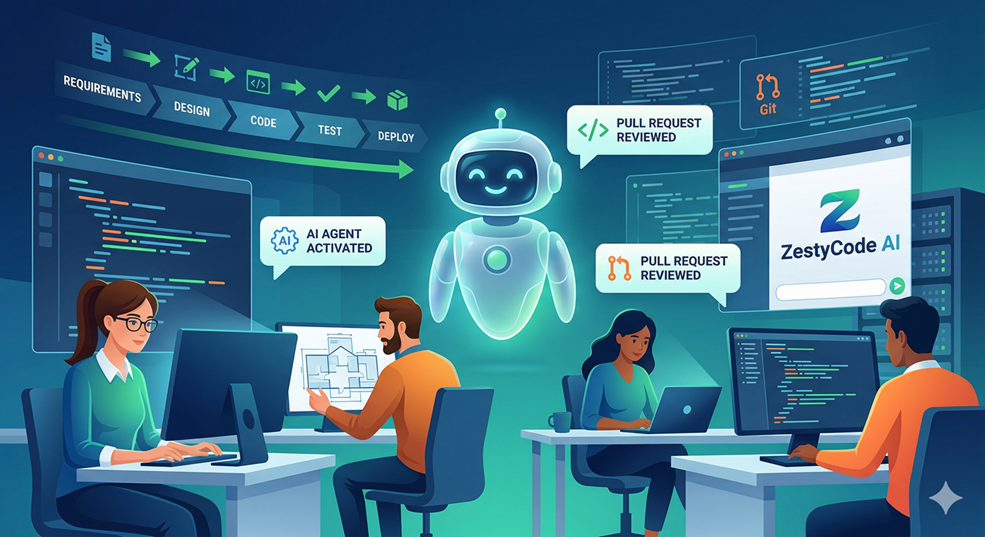
The transition from Conversational Assistants to Governed Sub-Agents replaces human-driven copy-paste loops with autonomous, event-driven background workflows.
// Governed Sub-Agent Task Contract
interface GovernedSubAgentTask {
  taskId: "refactor-auth-dto";
  targetScope: ["src/dtos/auth.dto.ts", "src/controllers/auth.controller.ts"];
  verificationRules: [
    "tsc --noEmit",
    "eslint --max-warnings 0",
    "npm test -- auth.spec.ts"
  ];
  maxLoopIterations: 3;
}
Unlike chatbots, a Governed Sub-Agent operates directly within a sandboxed container. It reads the issue specification, constructs an AST-indexed context graph, performs code mutations, runs verification scripts locally, and self-corrects any compilation failures autonomously before surfacing a fully validated pull request.
The Deterministic SDLC Architecture
Building a deterministic agentic pipeline requires decoupling model reasoning from direct file system modification. At ZestyCode, our Governed SDLC Architecture enforces three strict boundary layers:
- Ingestion & AST Scoping Layer: Automatically extracts exact dependency subgraphs so the agent receives 100% accurate type signatures without token window bloat.
- Constrained Execution Engine: Uses grammar-constrained decoding (DSPy / BNF schemas) so model outputs strictly match expected TypeScript AST nodes.
- Verification Interceptor: Runs static analysis and synthetic unit test suites inside isolated WebAssembly / Docker containers. Any failure triggers a structured reflection loop rather than a prompt retry.
Transitioning from Chat Prompts to Autonomous Pipelines
Engineering organizations that transition from conversational chat widgets to governed sub-agent pipelines experience an immediate step-change in engineering velocity and codebase quality.
By moving AI out of the sidebar and embedding governed agents directly into CI/CD pipelines, engineering leaders eliminate prompt-engineering friction, enforce architectural consistency, and ensure every AI-generated line of code passes strict deterministic quality gates before reaching production.