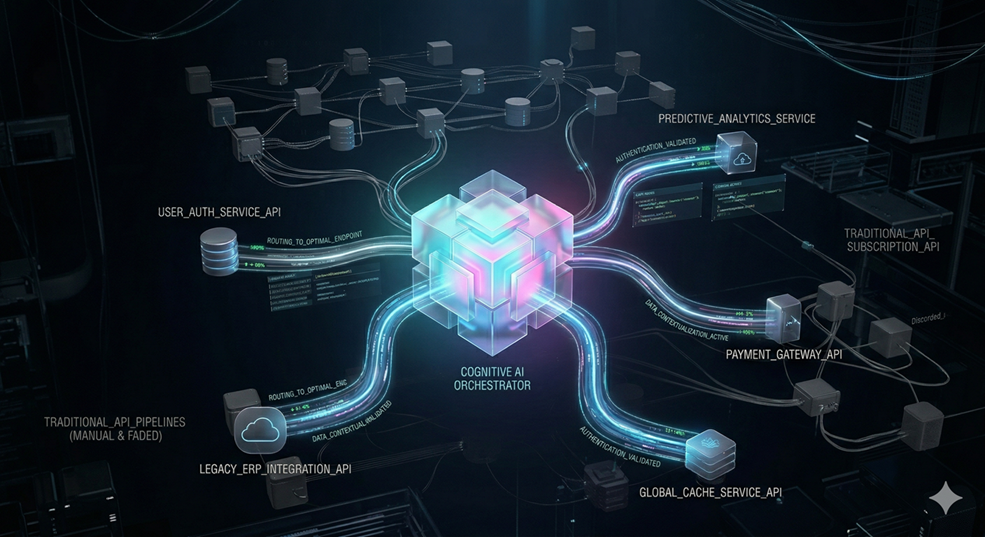
The Breakdown of Rigid REST Contracts
For over two decades, REST and GraphQL have governed backend system integration. Microservices were strictly bound by static schema contracts and predefined endpoint routes. When a client application required a new composite data view—combining user profiles, billing history, and real-time inventory—backend engineers were forced to write, test, and deploy specialized Backend-For-Frontend (BFF) aggregation endpoints.
This coupling created chronic friction across the Software Development Life Cycle (SDLC). Every new product feature required coordinated handoffs between frontend and backend teams, swelling sprint backlogs with routine API integration tasks.
Large Language Models (LLMs) equipped with native tool-use capabilities offer an alternative: Intent-Driven Data Orchestration. An LLM layer can receive a natural language query, dynamically inspect microservice OpenAPI specs, execute queries in parallel, and synthesize the result into the exact format requested by the client.
The Hazard of Unconstrained LLM Orchestration
However, replacing rigid REST pipelines with raw, unconstrained LLM prompts introduces severe architectural vulnerabilities into enterprise systems:
- Field Hallucination & Type Drift: A raw LLM may return
user_idas a string in one request and an integer in another, breaking downstream consumers. - Unbounded Latency & Cost Spikes: Without strict execution boundaries, an unconstrained model can enter multi-turn reasoning loops, bloating API latency to several seconds and burning token budgets.
- ACID Transaction Violations: LLMs cannot guarantee ACID compliance for atomic state mutations (such as payment processing or inventory allocation).
Unconstrained LLM Pipeline (High Risk):
[ Client Request ] ---> [ Raw LLM Prompt ] ---> Schema Drift / Missing Keys ---> Client Crash

Governed Cognitive Middleware (Deterministic):
[ Client Request ] ---> [ Intent Classifier ] ---> [ DSPy Compiled Pipeline ] ---> [ Schema Validator ] ---> [ Guaranteed Payload ]
Architecting Governed Cognitive Middleware
To solve the reliability paradox, leading enterprise architectures deploy Governed Cognitive Middleware. This pattern decouples natural language intent classification from strict data retrieval and payload serialization.
// Governed Middleware Signature Definition
import { z } from "zod";

export const CustomerAuditRequestSchema = z.object({
  customerId: z.string().uuid(),
  includeBillingSummary: z.boolean(),
  maxRecords: z.number().int().min(1).max(100),
});

export type CustomerAuditRequest = z.infer<typeof CustomerAuditRequestSchema>;
Instead of allowing the LLM to generate freeform text responses, the Cognitive Middleware uses the model strictly for Intent Classification & Parameter Extraction. The extracted parameters are validated against strict Zod or Pydantic schemas before any downstream API call is dispatched.
Schema-Rigid Decoding & Contract Enforcement
The core technical breakthrough in Governed Cognitive Middleware is Grammar-Constrained Decoding.
By enforcing strict Backus-Naur Form (BNF) grammars or JSON Schemas directly at the model token sampling level, the LLM is physically incapable of emitting tokens that violate the expected payload interface.
This eliminates an entire class of runtime errors, guaranteeing 100% schema compliance for API orchestration.
Production Benchmarks: Latency, Cost & Reliability
Engineering teams evaluating Cognitive Middleware against traditional REST BFF architectures observe significant performance improvements when governed correctly:
- Integration Velocity: New client data views can be deployed in hours rather than multi-sprint engineering cycles.
- Zero Schema Drift: 100% type safety achieved through grammar-constrained decoding and runtime schema intercepts.
- Token Efficiency: 65% reduction in token consumption compared to unconstrained chain-of-thought prompting by restricting LLM calls strictly to parameter extraction.
By combining the adaptive power of LLMs with deterministic schema constraints, enterprise organizations unlock fluid backend orchestration without compromising production system stability.